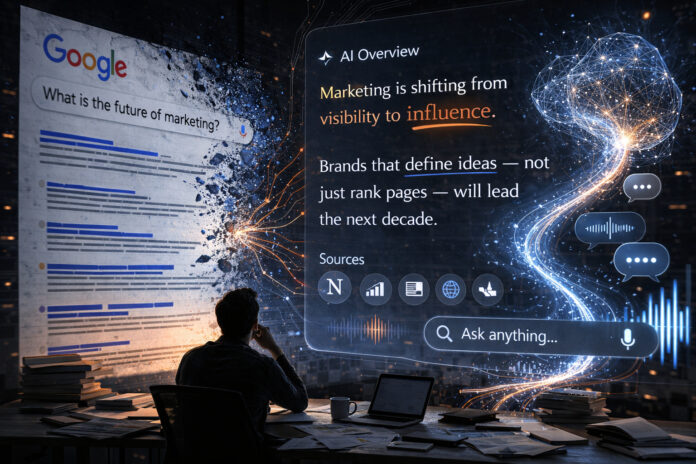
How AI-First Search Is Rewriting the Rules of Visibility in 2026
For most of the internet’s modern history, visibility meant one thing: appearing on the first page of Google.
The architecture was simple. A user typed a query. A list of blue links appeared. Publishers competed for position. Traffic flowed to the top.
That architecture is dissolving.
In its place, a new interface is emerging — one that does not point to information, but delivers it. AI-generated summaries, conversational responses, predictive answers layered above traditional results. Increasingly, users are not choosing between links. They are receiving conclusions.
And in that subtle shift — from navigation to synthesis — the economics of content are being rewritten.
From Search Engine to Answer Engine
The early web rewarded discoverability. The AI-first web rewards extractability.
Large language models integrated into search engines now summarize, condense, and interpret information before a user ever encounters a publisher’s page. Google’s AI-generated overviews, along with platforms like ChatGPT and Perplexity, no longer act solely as directories. They function as intermediaries — editorializing, selecting, and reshaping knowledge in real time.
The result is what analysts call the “zero-click acceleration.” Even before generative AI, research by firms like SparkToro showed that more than half of Google searches ended without a click. With AI summaries answering informational queries directly, that number has climbed further.
But this is not merely a traffic story. It is a power story.
In the blue-link era, ranking meant exposure. In the AI era, being cited — or being silently absorbed — determines whether a brand is visible at all.
The Invisible Filter
Behind every AI-generated answer is a retrieval system: a mechanism that selects which sources are credible enough to inform the response. Research in retrieval-augmented generation (RAG), published in journals such as Nature Machine Intelligence, shows that these systems favor structured, high-consensus, clearly defined information.
In other words, clarity is currency.
Vague marketing language, keyword-stuffed blog posts, and surface-level explainers are structurally disadvantaged. AI systems prefer content that defines terms precisely, reinforces consistent entities, and aligns with widely corroborated knowledge.
This creates a quiet but profound shift. The competition is no longer simply for ranking position. It is for inclusion within the model’s synthesized answer.
A Case Study in Disappearance
Consider a mid-sized B2B analytics software company that, until recently, relied heavily on informational search traffic. Its educational articles on predictive analytics and machine learning consistently ranked on the first page of Google. Organic traffic fueled demos, whitepaper downloads, and sales conversations.
Then AI summaries arrived.
Within a year, informational traffic fell by more than 30 percent. The drop did not correspond to a decline in search interest; demand remained steady. What changed was user behavior. Queries that once required reading multiple sources were answered instantly at the top of the page.
An internal audit revealed something more unsettling: when AI systems generated explanations of predictive analytics, they cited academic journals, industry standards bodies, and Wikipedia — but not the company’s content.
The firm had optimized for keywords. It had not optimized for authority extractability.
In response, the company restructured its content strategy entirely. Instead of producing more high-volume blog posts, it built a comprehensive knowledge hub: clearly defined terminology, structured research citations, proprietary data reports, and author profiles tied to real subject-matter experts. Schema markup clarified entity relationships. Definitions were written for precision rather than persuasion.
Traffic did not fully recover. But something else happened. Branded search queries increased. Sales calls referenced AI-generated summaries that now included the company’s frameworks. Visibility shifted from page ranking to conceptual ownership.
The lesson was stark: in the AI-first ecosystem, influence survives even when clicks decline.
The Compression of the Funnel
Traditional digital marketing operated on a linear assumption: attract traffic at the top of the funnel, nurture through retargeting, convert at the bottom.
AI compresses that journey.
When a user asks an AI system for the “best predictive analytics platforms for retail,” the answer often blends definition, comparison, and recommendation into a single synthesized response. Discovery and evaluation merge. The first impression may also be the last.
Marketing scholars have long argued that cognitive shortcuts shape consumer choice. Generative AI accelerates this principle. By presenting distilled conclusions, it reduces the friction of research — and in doing so, narrows the window in which brands can differentiate themselves.
If a company’s perspective is not embedded within that synthesis, it risks being excluded from consideration entirely.
The Rise of Knowledge Architecture
The response, increasingly, is structural.
Content strategy in 2026 is less about volume and more about architecture. Instead of publishing isolated blog posts around keyword clusters, leading organizations are designing interconnected knowledge systems. Core concepts are defined with academic precision. Supporting pages reinforce those definitions. Data is cited. Terminology is consistent.
The website becomes less a marketing channel and more a knowledge base — engineered not only for human readers, but for machine interpretation.
This shift mirrors findings in computational linguistics: models retrieve and synthesize information more reliably when entities are clearly disambiguated and hierarchically structured. In practical terms, that means brands that clearly articulate what they are — and what they are not — increase their probability of being referenced.
Original Research as Strategic Defense
There is another consequence of AI-first search: commoditized content loses leverage.
Large language models are trained on vast corpora of publicly available information. Generic advice is easily replicated. What cannot be easily replicated is original data.
Marketing science research consistently shows that proprietary insights increase perceived authority and trust. In an AI-mediated environment, original research also increases citation probability. Unique statistics, industry surveys, and distinct conceptual frameworks provide something models cannot merely average out.
In a world of synthesis, originality becomes insulation.
The Quiet Redistribution of Authority
None of this signals the end of search. But it does signal the end of search as we knew it.
The familiar hierarchy — ten links competing for attention — is giving way to a layered system in which AI acts as editor, curator, and interpreter. Authority accrues not only to those who rank, but to those who are embedded within the model’s understanding of a topic.
The danger for brands is not declining traffic alone. It is conceptual erasure. If competitors are consistently cited in AI-generated answers while you are absent, the market’s perception of expertise gradually shifts.
Visibility becomes less about position and more about presence within the narrative itself.
A New Definition of Winning
In 2026, winning in search does not necessarily mean attracting the most visitors. It means shaping the answer before it is delivered.
The brands that adapt are treating content not as a campaign, but as infrastructure. They are investing in semantic clarity, research-backed authority, and structural coherence. They are monitoring how AI systems represent their industries. They are asking not only, “Do we rank?” but, “Are we referenced?”
The era of blue links rewarded optimization tactics. The era of AI-first search rewards intellectual ownership.
The interface has changed.
The competition has not disappeared.
It has simply moved upstream — into the architecture of knowledge itself.