Marketing has never been purely about logic. While brands often assume consumers make rational decisions based on product features, price, or quality, behavioral science tells a different story. Human decisions are largely influenced by cognitive biases—mental shortcuts that help the brain process information quickly but often lead to predictable deviations from rational thinking.
These biases shape how consumers perceive brands, evaluate offers, and ultimately decide what to buy. Understanding them does not mean manipulating consumers; rather, it allows marketers to design messages that align with the natural way people process information.
In today’s highly competitive markets, where consumers face thousands of messages every day, the brands that succeed are not necessarily those with the best product—but those that understand how the human mind works.
Why Cognitive Bias Matters in Marketing
The concept of cognitive bias gained widespread recognition through the work of Daniel Kahneman and Amos Tversky, whose research on behavioral economics revealed that human decisions are heavily influenced by intuitive thinking rather than rational analysis.
Kahneman’s famous System 1 and System 2 framework explains this clearly.
- System 1: Fast, intuitive, emotional thinking
- System 2: Slow, analytical, rational thinking
Most purchasing decisions occur in System 1, meaning consumers rely heavily on mental shortcuts rather than deliberate reasoning.
For marketers, this creates both a challenge and an opportunity. If messaging fails to align with these mental shortcuts, it risks being ignored. But if messaging works with cognitive biases instead of against them, it can significantly increase engagement, trust, and conversion rates.
Key Cognitive Biases That Shape Consumer Behavior
1. The Anchoring Effect
The anchoring bias occurs when consumers rely heavily on the first piece of information they encounter when making a decision.
In pricing strategies, this effect is widely used.
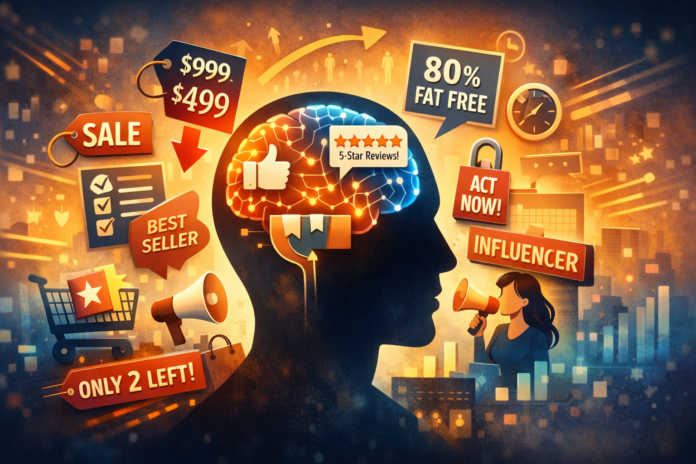
When a luxury brand displays a product originally priced at $900 but discounted to $450, the initial price becomes the psychological anchor. Even if the product’s real market value is closer to $400, the consumer perceives the $450 price as a bargain.
Amazon frequently uses this technique by displaying:
- Original price
- Discount percentage
- Current price
The original price sets the anchor, making the final price appear more attractive.
For marketers, the implication is clear: the first number consumers see often determines how they evaluate the entire offer.
2. Social Proof: The Power of Collective Behavior
Humans are social creatures. When faced with uncertainty, people tend to follow the behavior of others. This is known as social proof.
Research by psychologist Robert Cialdini shows that individuals are more likely to adopt a behavior if they believe many others are already doing it.
Modern digital platforms are built around this principle.
Examples include:
- “Best seller” labels
- Customer reviews and ratings
- “Over 1 million users worldwide” claims
- Influencer endorsements
Netflix’s recommendation system uses social proof indirectly by highlighting “Trending Now” content. The message is subtle but powerful: if many people are watching this show, it must be worth watching.
For marketers, social proof reduces consumer uncertainty and increases perceived trust.
3. The Scarcity Effect
The scarcity bias occurs when people assign greater value to things that appear limited or difficult to obtain.
This principle is heavily used in both digital and physical retail environments.
Examples include:
- “Only 3 items left in stock”
- “Offer ends tonight”
- “Limited edition”
Booking.com has mastered this technique. When users search for hotels, the platform often displays messages such as:
“Only 2 rooms left at this price.”
This message creates urgency and pushes consumers toward faster decisions.
However, the key to using scarcity effectively is credibility. If consumers sense artificial urgency, the strategy can backfire and damage brand trust.
4. The Framing Effect
The way information is presented can dramatically influence how people perceive it.
Consider the difference between these two messages:
- “90% fat-free”
- “Contains 10% fat”
Both statements describe the same product, yet consumers perceive them differently.
This phenomenon, known as the framing effect, demonstrates that presentation can matter more than factual content.
In healthcare marketing, treatments described as having a 90% survival rate tend to be preferred over those described as having a 10% mortality rate, even though both statistics represent the same reality.
For marketers, framing can transform how consumers interpret product benefits.
5. The Loss Aversion Principle
According to behavioral economics research, people fear losses more than they value equivalent gains.
This is called loss aversion, and it is one of the strongest drivers of human decision-making.
Consumers are more motivated by messages such as:
- “Don’t miss this opportunity”
- “Avoid paying more later”
- “Secure your discount today”
Subscription services frequently use this bias when reminding users about expiring offers or limited trial periods.
Instead of emphasizing potential gains, the messaging focuses on what consumers might lose if they do not act.
Turning Cognitive Bias Into Strategic Advantage
Understanding cognitive bias is not about manipulating consumers. Ethical marketing requires transparency and respect for consumer autonomy.
However, brands that ignore behavioral insights often struggle to communicate effectively.
To use cognitive bias strategically, marketers should focus on three principles:
1. Align Messaging with Natural Decision Patterns
Consumers do not process information like economists. Marketing messages should reflect how real people think and decide.
2. Combine Multiple Biases
The most effective campaigns often combine several behavioral triggers simultaneously.
For example:
- Social proof (“Over 500,000 customers”)
- Scarcity (“Limited availability”)
- Anchoring (“Previously $299, now $149”)
Together, these cues reinforce each other.
3. Maintain Authenticity and Trust
If consumers detect manipulation, cognitive bias strategies can quickly damage brand credibility.
Long-term brand success requires trust as much as persuasion.
The Future of Behavioral Marketing
With the rise of AI-driven marketing platforms, cognitive bias is becoming even more important.
Artificial intelligence can now analyze behavioral data at scale, enabling companies to personalize messages based on psychological patterns rather than just demographic segmentation.
Companies like Amazon, Netflix, and TikTok already integrate behavioral signals into their algorithms, predicting what users are most likely to engage with.
As marketing becomes increasingly data-driven, understanding cognitive bias will remain one of the most valuable skills for marketers.
Because at the end of the day, marketing is not just about products or campaigns.
It is about understanding people.
And people, as behavioral science consistently shows, rarely decide purely with logic.
___
References
- Kahneman, D. (2011). Thinking, Fast and Slow. Farrar, Straus and Giroux.
- Kahneman, D., & Tversky, A. (1979). Prospect Theory: An Analysis of Decision Under Risk. Econometrica, 47(2), 263–291.
- Tversky, A., & Kahneman, D. (1974). Judgment Under Uncertainty: Heuristics and Biases. Science, 185(4157), 1124–1131.
- Cialdini, R. (2009). Influence: Science and Practice. Pearson Education.
- Thaler, R., & Sunstein, C. (2008). Nudge: Improving Decisions About Health, Wealth, and Happiness. Yale University Press.
- Ariely, D. (2008). Predictably Irrational: The Hidden Forces That Shape Our Decisions. HarperCollins.