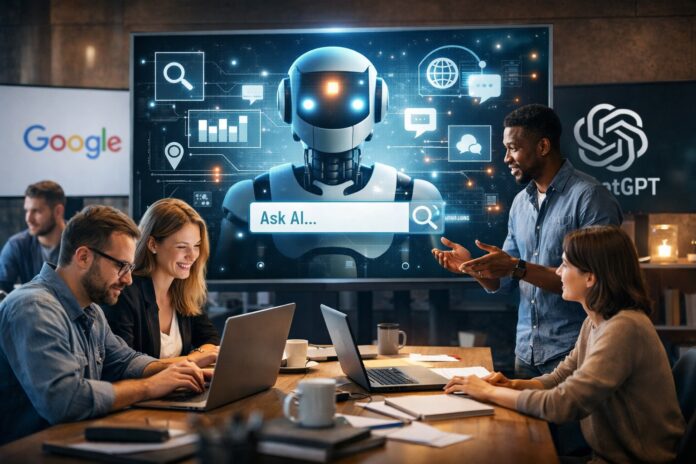
A silent but powerful shift has been reshaping the digital landscape in recent years. For more than two decades, Google was the unquestioned gateway to information. While it remains a massive traffic powerhouse today, it is no longer the sole authority over how people search, learn, and make decisions. Systems like ChatGPT, Claude, and Perplexity are fundamentally transforming the way users gather information. Instead of jumping across dozens of links, people now prefer receiving the answer, the analysis, and even the recommendation in one single step. This leads to a clear question: Is search really moving from Google to ChatGPT? Yes—faster than most people realize.
For many users, search is no longer a list; it’s a conversation. Google’s results—particularly in categories overwhelmed by advertisements and SEO-driven noise—have become increasingly difficult to navigate. A user visits a page, avoids the ads, closes pop-ups, scrolls through long paragraphs, and attempts to extract value. But with systems like ChatGPT, the process is linear: Question → Summary → Analysis → Recommendation. This aligns perfectly with how the human brain prefers to process information. Users do not just want “the correct answer” anymore; they want “the smartest answer that helps them make the best decision.”
Zero-Click Searches (Google 2019 → 2024)
- 2019: 50%
- 2021: 56%
- 2024: 62%
62% of users no longer click any website after searching on Google—meaning brands are losing traffic even with strong SEO.
Zillow—America’s largest real estate platform—introduced a proprietary “AI Schema Layer” in 2024 designed to make its content readable not only for Google but also for AI agents. Goal: When users ask ChatGPT, “What is the most reliable mortgage calculator?”, Zillow becomes the named recommendation. Result: A 38% increase in AI-suggested organic traffic. HubSpot aggregated anonymized CRM usage data to build “proprietary benchmarks” unavailable anywhere else. These benchmarks quickly became reference points cited by AI systems. This unlocked a visibility level that was impossible through traditional SEO alone and created a new metric: AI-attributed authority.
AI-Search Adoption (2023 → 2025 Forecast)
- 2023: 12%
- 2024: 28%
- 2025 (forecast): 43%
Usage of ChatGPT, Claude, and Perplexity is growing at a rate exceeding 250% in just three years.
For the SEO ecosystem, this shift doesn’t represent a technical update—it represents an entirely new rulebook. Traditional SEO relied on keyword optimization, backlinks, and technical foundations. But today, the game has evolved beyond keywords. The core idea highlighted in the conversation between Kevin Indig and Gianluca Fiorelli is this: SEO has transitioned from a keyword-centric model to an entity-centric model. Both Google and AI systems like ChatGPT and Perplexity care about who your brand is, what you stand for, what domain you own, and how strongly the digital world validates your authority. This makes proprietary data not just a competitive edge but a necessity.
One of the most important behavior shifts in the AI-first search era is what we call “agentic search.” AI is no longer just a response engine—it behaves like a decision engine. When a user asks, “What is the best nonwoven bag production machine?”, Google used to display blogs, product lists, and forum posts. Today, AI systems analyze brand authority, technical product data, customer reviews, trust signals, and industry relevance simultaneously—then present a single optimized recommendation. This makes one thing clear: companies are not just competing for SEO rankings anymore; they are competing for AI visibility.
This leads to a bigger truth for brands: SEO is now inseparable from PR, brand power, content quality, influence, and trust signals. Technical SEO alone no longer guarantees visibility. Quotable content, executive presence, expert commentary, social visibility, news mentions, and overall digital reputation now directly shape how AI systems interpret and display a brand. Showing up on Google SERP is no longer the end goal—it has become a stepping stone to the real objective: being present inside the AI answer box. Search isn’t dying; it’s transforming. Google remains the largest information archive, but users no longer want to navigate that archive manually. AI systems extract, filter, and deliver insights in a format tailored to human decision-making. In this new world, brands need far more than classic SEO. They need authority, data, trust, influence, and an AI-readable identity. Perspective is changing and all brands must focus all areas, sections and channels. As a manager for your brand, you should know answers for:
- Is your Google Knowledge Panel accurate and up-to-date?(assets – brand signals)
- Are your brand entities properly defined and connected? (assets – brand signals)
- Do your executives have strong digital visibility? (assets – brand signals)
- Do you publish unique datasets AI can cite? (data-owner & analytics)
- Do you offer benchmarks, reports, or research insights? (data-owner & analytics)
- Are your technical explanations supported by real data? (data-owner & analytics)
- Are your articles structured in long, coherent paragraphs? (ai & readible content)
- Do you include Q&A style “AI-friendly FAQ” blocks? (ai & readible content)
- Do you use schema, JSON-LD, and entity tagging? (ai & readible content)
- Do your leaders appear in media, podcasts, or events? (pr & authority boost)
- Is your brand mentioned in trusted international sources? (pr & authority boost)
- Are your products referenced by independent experts? (pr & authority boost)
- Are your product reviews consistent and positive? (social & review metrics)
- Is your LinkedIn presence strong and active? (social & review metrics)
- Does your brand generate stable engagement patterns? (social & review metrics)
Brands that understand and embrace this shift early will grow in the AI-first era. Those that don’t will fade into invisibility. For years, I created blog content and earned barely anything from Google AdSense—literally cents. While Google made millions off our work, the actual creators like us were getting paid 50–60 cents. Around five or six years ago, the European Union finally stepped in with a copyright directive to protect publishers, and now many countries, including Turkey, are beginning to adopt similar systems. But here’s the ironic part: back then, Google exploited publishers and made millions, while we couldn’t sustain our platforms with the few pennies we earned—and many of us had to shut down. Now, AI has started exploiting Google and is taking millions from its revenue pie. In short, the tables have turned.
Yet the real producers—the ones who actually create value—are still left with empty pockets. What can we say? We keep creating so at least people can benefit.